Sealed behind a heavy cast-iron gate, a deep sandstone shelter, still sacred to the Chumash people, contains some of the most significant rock art on the West Coast. The Chumash Painted Cave in San Marcos Pass in the Santa Ynez Mountains contains vibrant red, white, and black designs believed to date back at least 500 years.
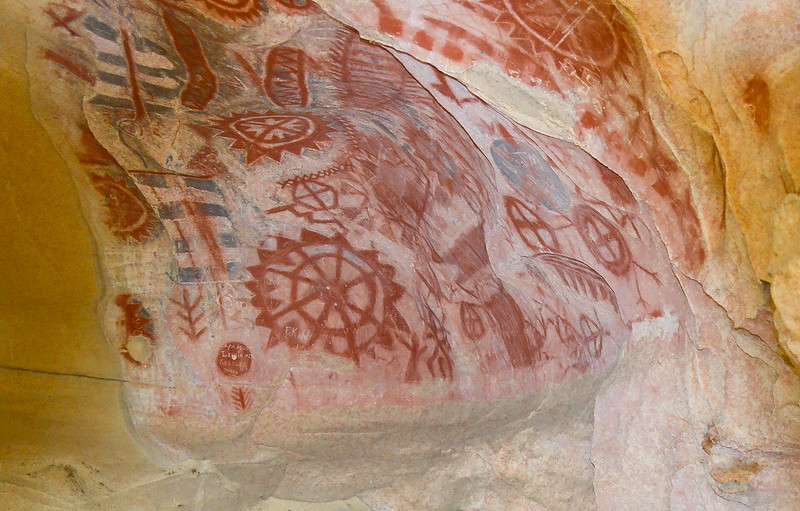
Seeing this site for the first time inspired my ongoing fascination with the Chumash and their rich visual culture. In following months and years, I traveled across Santa Barbara and Ventura Counties to find and document other Chumash rock art sites.
CHALLENGE and inspiration
Until the last few decades, rock art photographers had only their own eyes and cameras to rely on in the field. Rock art sites are often located deep in the backcountry, requiring hours of travel, detailed navigation, and sometimes crawling into narrow alcoves, caves, or overhangs in search of faint traces of pigment. It’s often a race against fading daylight, shifting shadows, or the threat of incoming weather. These conditions mean that a software tool enabling quick assessment and enhancement on the spot can provide immense value – saving not only time, but entire trips.
One of my early mentors in rock art research and documentation was Tom Hnatiw, a dedicated and talented rock art photographer with unmatched knowledge and enthusiasm for these sacred places and indigenous culture. He introduced me to Jon Harman’s DStretch — a pioneering image enhancement tool that uses decorrelation stretch to digitally enhance pigments obscured by weathering, accidental damage, or vandalism. This statistics-based enhancement technique — also used in satellite imaging to highlight subtle color differences — is described in the NASA/JPL paper by Ronald Alley (1996).¹ On many trips, the mobile version of Jon Harman’s software, iDStretch, turned out to be the difference between capturing an entire figure, element – or even whole panel – or missing it completely.
After teaming up with Tom and learning how to use DStretch in my own photos, I began contributing my skills as part of Tom’s collaborative research with Albert Knight, an archaeologist specializing in the indigenous cultures and rock art traditions of Los Angeles County. In one trip in 2018, while documenting another site with our team, I noticed a small trace of what looked like red pigment in the corner of a rock. Using iDStretch revealed a truly remarkable find, which Knight has called:
“easily the most elaborate and interesting pictograph site in the eastern part of Los Angeles County.”²
Featuring dozens of geometric and anthropomorphic pictographs, nearly all invisible to the naked eye, this extraordinary panel is believed to have been painted by the Serrano or Tongva people hundreds or thousands of years ago.
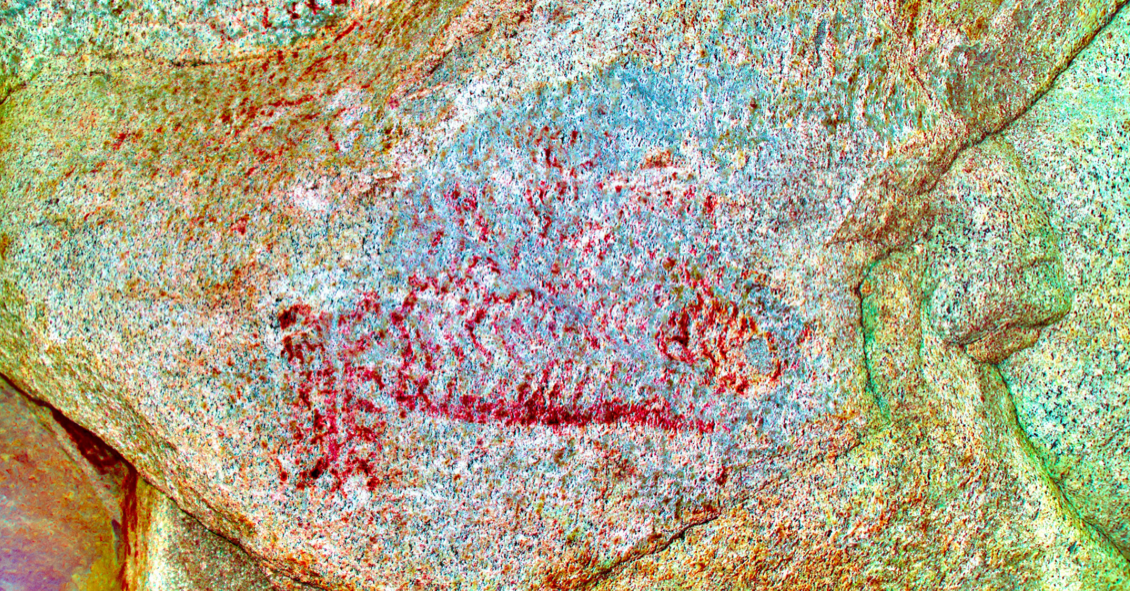
This experience made clear how rock art can be almost invisible to the unaided eye or mistaken for naturally occurring colors, mineral stains, or lichen. I wondered just how much indigenous visual culture could be “hidden in plain sight,” yet currently lost to history? This color enhancement technology meant that hundreds, even thousands, of sites across the Southwest now deserve to be revisited and re-documented.
First Steps
Given the time-intensive and demanding nature of rock art documentation, I decided to leverage my skills to combine everything I’d learned into a practical, intuitive way to improve both efficiency and accuracy of in-field color enhancements. In my own experience, and through consultations with others in the field, I came to realize that perhaps the most urgently needed technology was running enhancement software directly on the live camera. This ability would prevent needing to take and enhance a single photo at a time – offering the flexibility of simply “scanning” one’s device around the rock surface to look for traces of pigment.
With this goal in mind, earlier this year I started experimenting with software color enhancement using the Swift language on iOS platforms. I aimed to create a real-time decorrelation stretch mobile app that would streamline field discovery and jump-start visual analysis on-site. The process was difficult, including learning to code in Swift for the first time, but after a couple months I had the first working prototype for what became ChromaLens for iOS.
Prototyping and Refinement
Field testing the prototype at many of the California rock art sites I knew well proved essential for understanding how the algorithm performed on different pigments and under changing light conditions. Through my experience field testing, I conceived and developed other features that could improve the user experience, such as a color selector, the ability to record videos, and an advanced preprocessing pipeline. After several iterations, the concept for the app evolved into a suite of apps, similar to DStretch, but all of which support live video, color tuning and preprocessing steps.
The result is an intuitively designed mobile ChromaLens app, flexible enough for both beginner and expert users, currently in the Beta testing phase. I have also been developing a Mac desktop version: ChromaLens Studio, which is built for batch processing and multi-window workflows. Currently , the mobile app have received positive feedback from over 20 testers. See chromalensapp.com for the latest updates on the project, official release date and more.
The Future
The ChromaLens suite of tools, soon to be released for the Apple ecosystem, supports cultural preservation, scientific research, and visual discovery. I’ve realized that, besides rock art, there are potential applications, for example, in conservation, education, natural sciences, or creative research. Looking ahead, we are conducting R&D on a ChromaLens AR vesion running on Apple’s Vision Pro headset — allowing users to look around a site and see enhanced imagery overlaid directly on their surroundings. No phone, no tablet — just an immersive layer of insight added to the physical world.
David Gordon
Founder, Entoptic
1. Ronald E. Alley, 1996, Algorithm Theoretical Basis Document for Decorrelation Stretch, NASA, JPL.
2. Albert Knight, “A Synthesis of the Rock Art of Mainland Los Angeles County, California,” Journal of California and Great Basin Anthropology 41, no. 2 (2021): 266–291.